Research Mentor: Lisa Kelly, Professor, UMBC Chemistry and Biochemistry
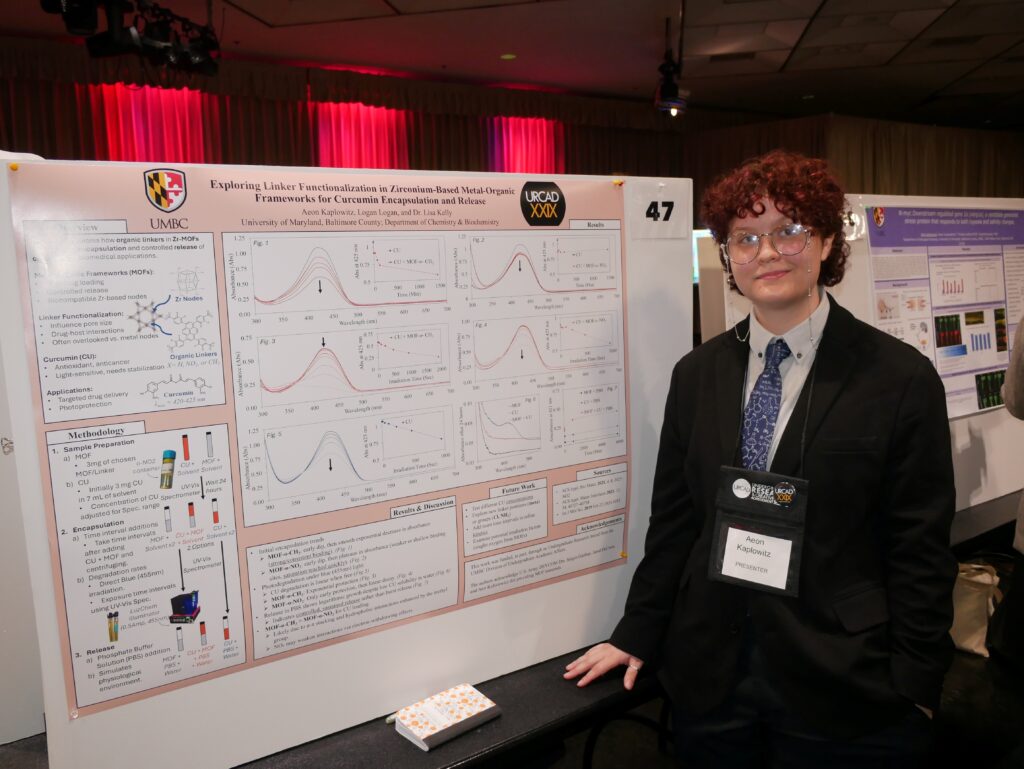
Structural Effects in Zr-MOFs on Curcumin Stability and Delivery
Research Overview
Curcumin is a natural compound with anti-inflammatory and anticancer potential, but it has low water solubility and degrades quickly under light, which limits its clinical use. Zirconium-based metal-organic frameworks (Zr-MOFs) are porous materials that can be tuned through pore size and linker chemistry, making them promising drug carriers. In this project, we studied how curcumin concentration, MOF pore size (NU-808, NU-901, NU-1000), and functionalized m-linkers (-CH₃, -Cl, -NO₂) affect encapsulation, photostability, solubility, and release in phosphate-buffered saline (PBS, pH 7.4). Encapsulation and release were measured using UV-Vis spectroscopy at 428 nm with baseline correction and normalized comparisons. Results showed that MOF pores saturated at about 8-12 µg curcumin per mg MOF. Smaller pores and modified linkers improved encapsulation and significantly increased protection against ambient-light degradation, likely due to stronger interactions and tighter confinement. However, these same modifications also reduced curcumin release in PBS, suggesting stronger host-guest binding. Larger-pore, unmodified systems showed faster release but less protection.
This study demonstrates that linker chemistry and pore size directly control curcumin stability and release behavior. Understanding these structure-function relationships can guide the design of MOF drug carriers that balance high loading with controlled therapeutic delivery.