Research Mentor: Lisa Kelly, Chemistry and Biochemistry
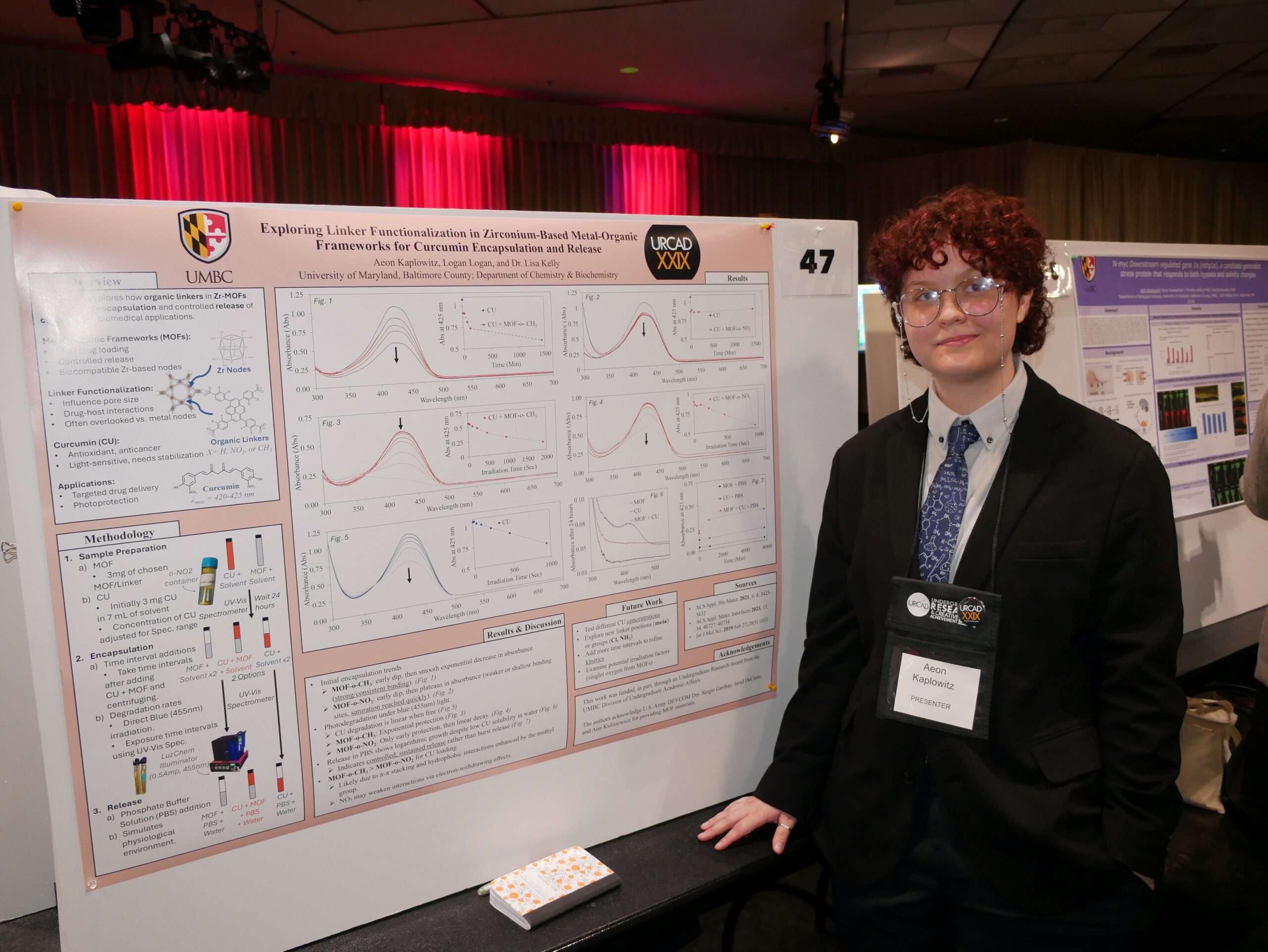
Exploring Linker Functionalization In Zirconium-Based Metal-Organic Frameworks For Curcumin Encapsulation And Release
Research Overview
Metal-Organic Frameworks (MOFs) have gained attention in biomedical applications for their tunable porosity, stability, and ability to modulate drug release. While most studies emphasize metal nodes, this research examines how functionalized TBAPy-based linkers in zirconium (Zr)-MOFs influence curcumin encapsulation and release. Linkers, the organic components connecting metal clusters, define pore size and chemical environment, affecting drug interactions. Curcumin, a bioactive compound with antioxidant and anticancer properties, is highly sensitive to photodegradation, limiting its therapeutic potential. Encapsulation within MOFs improves stability while enabling controlled release.
Curcumin (λmax ≈ 430 nm) was loaded into functionalized Zr-MOFs, and its encapsulation and release were monitored using UV-Vis spectroscopy and fluorescence. Phosphate-buffered saline (PBS, pH 7.4) simulated physiological conditions, revealing an absorption decrease followed by gradual recovery, suggesting controlled release.
Controlled drug release maintains therapeutic concentrations, reduces dosing frequency, and minimizes side effects. Rapid degradation or burst release can compromise efficacy or cause toxicity. Preliminary results suggest linker functionalization affects curcumin retention through π-π stacking and hydrogen bonding, while PBS triggers release. By shifting focus from metal nodes to linkers, this study informs MOF-based drug stabilization strategies.
The authors acknowledge U.S. Army DEVCOM Drs. Sergio Garibay, Jared DeCoste, and Ann Kulisiewicz for providing MOF materials.
This work was funded, in part, through an Undergraduate Research Award from the UMBC Division of Undergraduate Academic Affairs.
I am a recipient of a UMBC Travel Award from the UMBC Division of Undergraduate Academic Affairs